


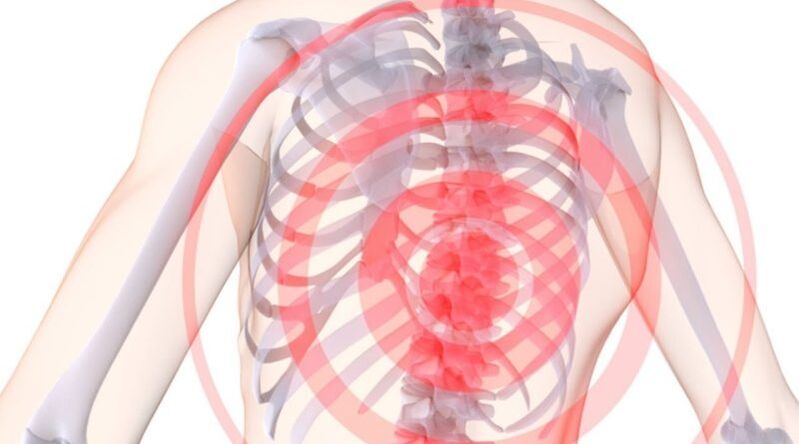
Osteochondrosis is a disease of the spine characterized by degenerative-dystrophic damage to the intervertebral discs, vertebral bodies and ligaments.
Osteochondrosis of the spine has a chronic progressive course.The disease does not make itself felt for a long time, and symptoms appear only when complications arise.
According to statistics from the World Health Organization, 40-80% of the world's population suffers from osteochondrosis.
Among patients, people over 30 years old predominate.But recently there has been a trend towards rejuvenation of osteochondrosis.Osteochondrosis ranks first among diseases of the spine in terms of disability among patients.
Brief anatomy of the spine
The spine performs the main functions - the spinal cord canal, support and movement, and also connects the head, shoulder and pelvic girdles.
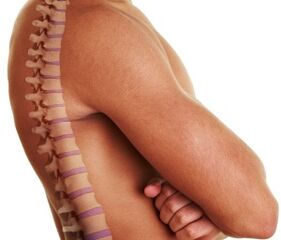
The structural unit of the spine is a vertebra.
The 24 vertebrae are connected together by intervertebral discs, which are the body's shock absorbers.
The spine is divided into five sections: cervical, thoracic, lumbar, sacral and coccyx.
The normal shape of the spine is S-shaped.
This configuration of the organ makes it possible to evenly distribute the weight and load of the body.
Structural and functional elements of the spine
A vertebra is a bony formation consisting of a body, an arch and processes.
The main load falls on the vertebral body, therefore it is its most massive part.
Important!The arches of adjacent vertebrae form the spinal canal - the receptacle for the spinal cord, blood vessels, spinal nerve roots and adipose tissue.
LigamentsThe spine is represented by the posterior longitudinal ligament, which connects the vertebrae along the posterior surface, and the ligamentum flavum, the main purpose of which is to connect the arches of the vertebrae.
Spinal processes.The vertebra has 7 processes which extend from the arch: the spinous process, two transverse articular processes, two upper and two lower.The ligaments and muscles of the spine are attached to the spinous processes.Other processes form the intervertebral joints of the spine.
Intervertebral discis a disc-shaped plate composed of a cartilaginous plate, a fibrous anulus and a nucleus pulposus.The intervertebral disc connects adjacent vertebrae, providing mobility and stability to the spine.
Intervertebral jointsformed by the processes of two adjacent vertebrae.The main function of the intervertebral joints is to move the vertebrae relative to each other and provide flexibility to the spine.
Intervertebral foraminaare located on the lateral sides of the spine and are formed by the articular processes, bodies and pedicles of the adjacent vertebrae.Spinal nerve roots exit through the intervertebral foramina and blood vessels enter them.
Spinal cord- This is a section of the central nervous system made up of nerve fibers.The spinal cord has three membranes: soft, arachnoid and hard.The spinal membrane of the dura mater consists of two sheets that connect and form the dural sac, filled with cerebrospinal fluid - cerebrospinal fluid.
Spinal nerve roots- They are conductors of nerve impulses from the spinal cord to the internal organs and vice versa.Each spinal nerve root has in its structure autonomic, sensory and nerve fibers.
Paravertebral muscles- these are the muscles of the spine which support it and ensure the inclinations and rotations of the body.
The functional unit of the spine isspinal movement segment, which consists of two adjacent vertebrae, an intervertebral disc, ligaments and muscles.
Pathogenesis (development mechanism) of spinal osteochondrosis
In the process of development, osteochondrosis passesfour steps:
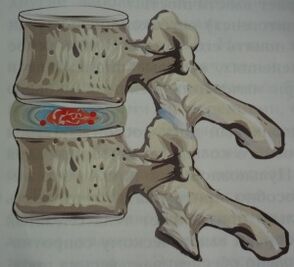
- First step.Pathological changes do not extend beyond the boundaries of the intervertebral disc.The nucleus pulposus dries out, leading to a decrease in the height of the intervertebral disc.The annulus fibrosus cannot withstand the load - it cracks and tears.
- Second step.Due to a decrease in the height of the intervertebral discs, sagging of the ligaments and muscles of the spine occurs, which leads to instability of the spinal movement segment.Vertebrae can slide and move relative to each other.In this case, spondylolisthesis is formed.
- Third step.The disease progresses.Protrusion of the intervertebral discs and osteoarthritis of the intervertebral joints as well as non-covertebral joints occur.
- Fourth step.At this stage, adaptive reactions are activated in the form of bony growths of the vertebral bodies (osteophytes).Thus, the body tries to limit excessive mobility of the vertebrae.Osteophytes, with their sharp edges, damage the roots of the spinal nerves.Fibrous ankylosis of the intervertebral discs and joints forms and the spine is immobilized.The ankylosis stage is characterized by the disappearance of pain.
What leads to osteochondrosis?
Osteochondrosis of the backis a multifactorial disease in which it is impossible to isolate a specific cause.
Osteochondrosis is based on a violation of microcirculation and metabolism in the tissues of the spine, which can occur due to improper distribution of the load on the spine.
Factors that contribute to the development of osteochondrosis include:
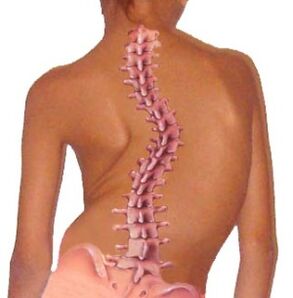
- poorly formed posture in childhood (scoliosis, kyphosis, kyphoscoliosis, curvature);
- weakness of the back muscles (incompetent muscular corset of the spine);
- stay in the same position for a long time (working at a computer, working in an office, doing crafts);
- improper lifting of weights;
- physical inactivity and sedentary lifestyle;
- metabolic pathology, in particular lack of calcium, phosphorus, calcium, vitamins, magnesium, zinc;
- genetic predisposition to osteochondrosis;
- infectious diseases;
- frequent hypothermia of the body;
- chronic stress;
- hormonal imbalance;
- weightlifting;
- spinal injury;
- overweight and obesity.
Symptoms of osteochondrosis
Chronic osteochondrosis can manifest itself with various symptoms.It all depends on the stage of the disease, the level of spinal damage and the presence of complications.
Clinically, the disease manifests itself when the degenerative-dystrophic process has already reached the posterior part of the annulus fibrosus and the posterior longitudinal ligament, then the spinal nerve roots are irritated, pinched, and the conduction of nerve impulses through them is disrupted.
At the same time, compression of the spinal cord and blood vessels occurs, which is manifested by reflex and compression syndromes.
Important!Pain syndrome in osteochondrosis occurs due to pinching of spinal nerve roots in the intervertebral foramina by osteophytes, muscle spasms and displaced vertebrae.
Osteochondrosis and its symptoms often mimic acute coronary syndrome, pleurisy, acute pancreatitis, hepatic and renal colic, acute appendicitis and adnexitis.
Therefore, it is important to conduct a thorough differential diagnosis of the disease to exclude life-threatening conditions.
The most commonsymptoms of osteochondrosis:

- pain in the neck, lower back, thoracic spine, which can be painful, throbbing or in the form of lumbago.The pain radiates to the head, upper and lower limbs, shoulder blades, heart and stomach.The pain syndrome worsens after physical activity, sneezing, laughing, coughing or staying in the same position for a long time;
- sensory disturbancedifferent parts of the body at the level of the innervation of the pinched nerve;
- spasmmuscles of the neck, back, upper and lower limbs;
- similar to a migraine headache;
- body achesin the joints of the limbs;
- increased fatiguephysical and mental work;
- dizziness and loss of consciousnesswith a sharp turn of the head (vertebral artery syndrome);
- visual impairment(floaters in front of the eyes or colored spots);
- decreased hearing acuity, tinnitus;
- heart pain;
- painalong the intercostal spaces;
- decreased blood supplyupper and lower limbs, which manifest as cold skin;
- paresthesia– crawling, tingling and burning sensations in the spine;
- dry skin;
- sweating disorder;
- urinary problems(dysuria, enuresis);
- decreased sexual desire, impotence.
Early diagnosis of osteochondrosis will greatly facilitate its treatment.
Methods for diagnosing osteochondrosis
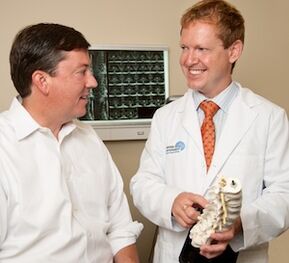
A neuropathologist diagnoses osteochondrosis.If necessary, patients can be referred for consultation to a cardiologist, gastroenterologist, orthopedist, surgeon and others.
During the interview, it is necessary to accurately determine the nature of the complaints, when they arose and what the patient associates them with.Be sure to check the patient's medical history, profession and whether any close relatives suffer from osteochondrosis.
Laboratory tests in this case are not informative.By carrying out a biochemical blood test, you can pay attention to the level of calcium, phosphorus and other trace elements.
The main place in the diagnosis of osteochondrosis is occupied by instrumental methods such as spinal radiography, computed tomography and magnetic resonance imaging.
X-ray examination of the spine is the simplest, most accessible and informative method for diagnosing osteochondrosis.
Mandatory x-ray is carried out in direct and lateral projections of the desired part of the spine.Osteochondrosis is characterized by: a decrease in the height of the intervertebral discs, the presence of osteophytes, osteoporosis and deformation of the spine.
Myelography- This is a radiological examination of the spine with the introduction of a contrast product into the spinal canal.This method is dangerous due to the occurrence of allergic reactions to the contrast.
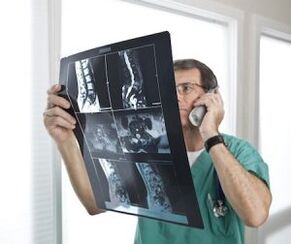
Myelography allows us to study the internal structure of the spinal canal.The method is useful for diagnosing Schmorl hernias (intervertebral hernias).
Computed and nuclear magnetic tomography– these are modern diagnostic methods that visualize the soft tissues and bones of the spine layer by layer.
These methods are expensive and therefore are used in severe cases, especially for the differential diagnosis of osteochondrosis and diseases with similar symptoms.
Since osteochondrosis is often disguised as diseases of the heart, lungs, pleura, stomach, intestines, kidneys and liver, differential diagnosis is necessary.
For this purpose, the patient may be prescribed an electrocardiogram, ultrasound of the heart and internal organs, a blood test for troponins, ultrasound of blood vessels, chest x-ray, electroencephalography and others.
Methods for treating osteochondrosis
Treatment of osteochondrosis can beconservative and surgical.
Important!First of all, comprehensive conservative methods are used, and surgical treatment is used only in extreme cases.
Let's figure out how to properly treat osteochondrosis.KconservativeMethods for treating osteochondrosis can be listed:
- drug therapy;
- physiotherapy;
- physiotherapeutic methods;
- manual therapy;
- massage;
- acupuncture.
Drug treatmentOsteochondrosis aims to relieve pain, relax muscles, relieve swelling of nerves and muscles, improve blood circulation and conduction of nerve impulses.For this purpose, the following groups of drugs are used:
- non-steroidal anti-inflammatory drugs;
- chondroprotectors, which include components of cartilaginous tissue.These drugs protect the cartilage of the vertebrae and intervertebral discs from the negative effects of various factors;
- diureticswhich remove excess fluid from the body and relieve swelling of the spinal nerve roots and paraspinal muscles;
- muscle relaxersrelax tense muscles;
- drugs, improving metabolism and microcirculation in spinal tissues (vitamins B1, B6, B12, C, A and E);
- calcium supplements;
- hormonal drugs, which are prescribed when nonsteroidal anti-inflammatory drugs are ineffective.
Therapeutic exercise– these are dosed physical activities that can be practiced both at home and at work for the treatment and prevention of osteochondrosis.

There are many sets of exercises for osteochondrosis.Prescription of exercise therapy and monitoring of its implementation is carried out by a qualified specialist - a physiotherapist doctor.
Through properly selected exercise therapy, you can relieve pain, improve mobility and blood supply to the spine, and stop the progression of the disease.
Physiotherapeutic treatmentosteochondrosis is carried out in special physiotherapy departments of hospitals, sanatoriums and dispensaries by a physiotherapist.
Physiotherapeutic methods include: electrophoresis, magnetic therapy, laser therapy, mud therapy, balneotherapy, ultraviolet exposure of the affected part of the spine, vibration treatment and others.
Manual therapy– this is a measured manual impact on the spine to restore its mobility, eliminate the displacement of the vertebrae and intervertebral discs.

Manual therapy should only be performed by a qualified chiropractor.
Massage and self-massagefor osteochondrosis, it is carried out to relieve muscle spasms, improve microcirculation in the paravertebral tissues and increase the mobility of the spine.
Acupunctureis a method of treating osteochondrosis in which thin needles are injected into active points.
Under the influence of needles in the body, the level of endogenous opiates and cortisol increases, which have anti-inflammatory and analgesic effects.
Prevention of osteochondrosis
To maintain your health and your spine to remain mobile until old age, follow several principles of osteochondrosis prevention:
- watch your posture– always keep your back straight, do not slouch;
- choosecorrect postureto sleep;
- sit correctly at the table(shoulders relaxed, back straight, furniture must be adapted to your height);
- during a long stay in one position (working in an office, at a computer, sitting at crafts), try every 1-1.5 hoursdo some physical exercise, self-massage of the back, or simply get up and walk;
- distribute the load correctlyon the spine when lifting and carrying various weights;
- wear orthopedic shoes;
- healthy sleepon a flat, hard to moderately hard mattress.It is better to purchase an orthopedic mattress and pillow.
Osteochondrosis of the spineis a chronic progressive disease that, unfortunately, cannot be cured.The effectiveness of treatment directly depends on its speed.
Do not self-medicate so as not to make your condition worse.At the first signs of osteochondrosis, contact a neurologist.